
The Beginning
3 agile nerds got together and started talking about how agile coaches need to prepare themselves internally, for when they engage a new team or new orgs.
Here are the team members – Ryan, Alex Dilshan






Sprint One
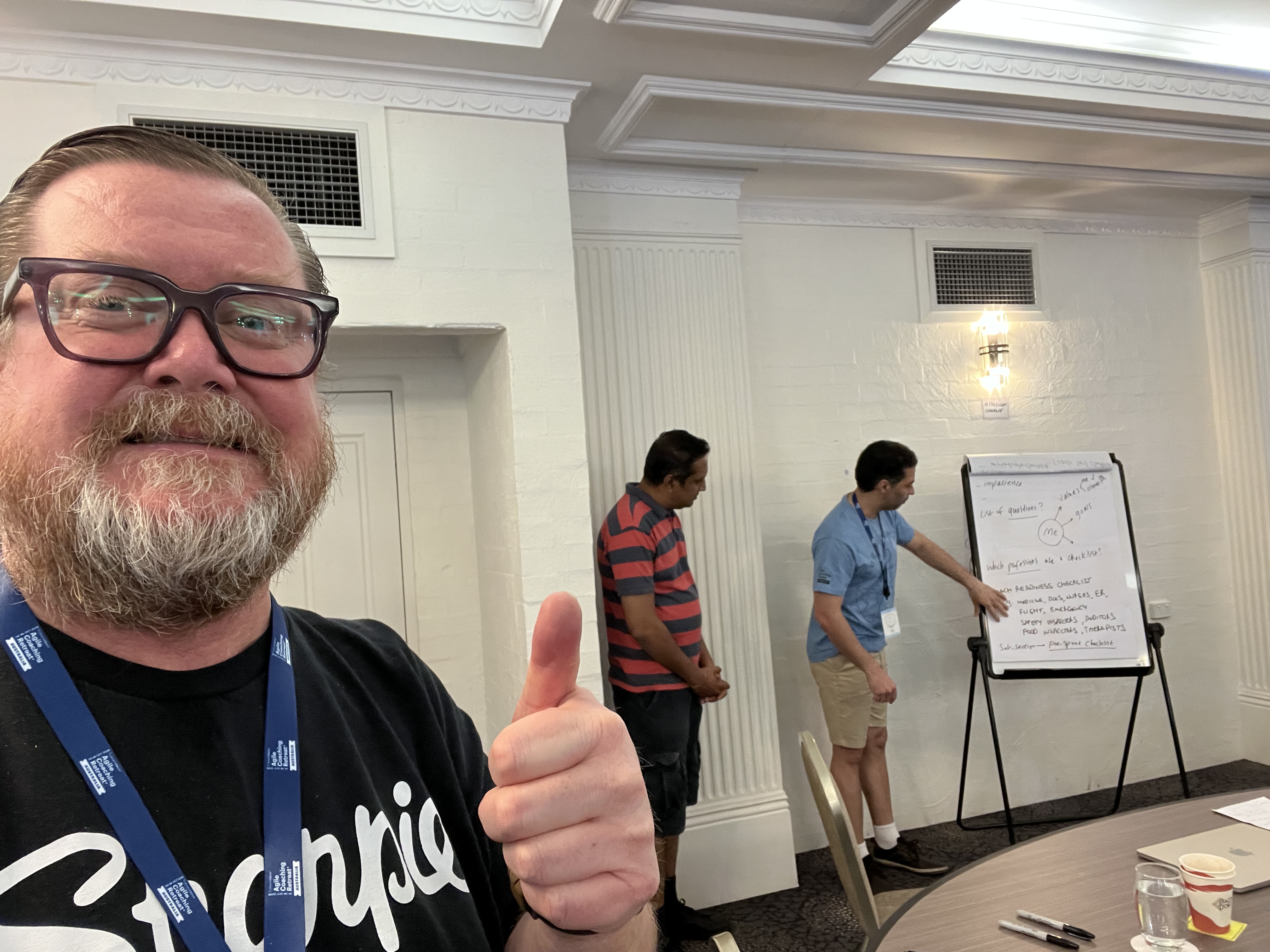
We created our team name, took some selfies, and started to build a list of relevant biases and errors that coaches fall into :
Fundamental Attribution Error: Blaming and labeling individuals rather than seeing the organization as a system that drives that behavior
Impact: Blaming the wrong thing and leading to Tunnel Vision
Agile Example: Labeling individuals as “resistant to change” instead of considering the organization culture when implementing Scrum at a university
Optimism Bias and Catastrophizing: The two extreme ends of falsely hoping for the best and the worst of the implementation effort
Impact: For Optimism, you assume the best so you fail to inspect and adapt. For catastrophizing, you assume the worst, so you don’t make progress
Agile Example: When an Agile coach talks about the best team they have had ( forgetting that they have had faults and have not always been perfect! Regarding catastrophizing, it could lead an Agile coach to fail to see the achievements a team have made because they don’t compare with the perfect version.
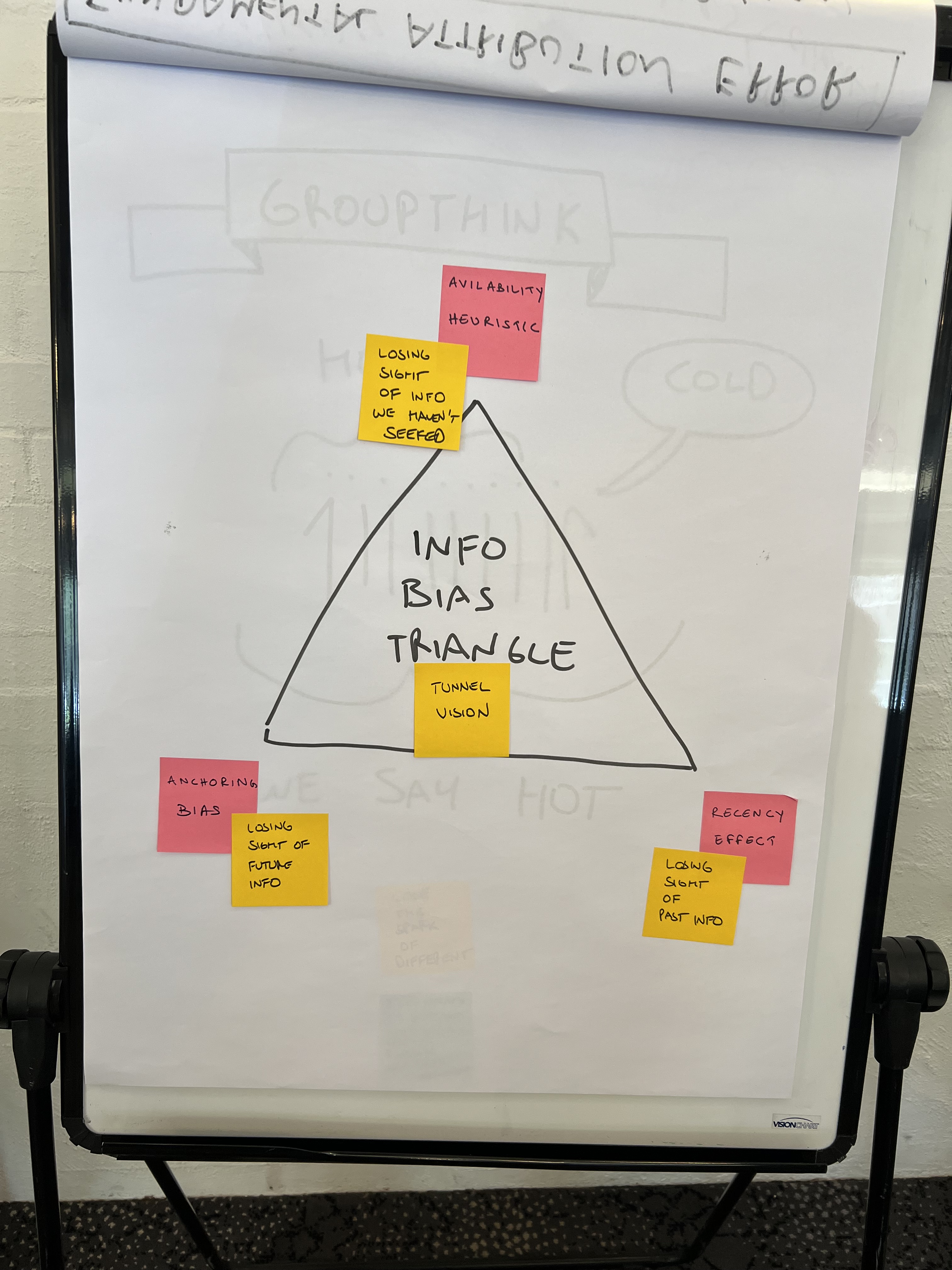
Availability Heuristic, Anchoring Bias and Recency Effect: Making decisions and judgments based the most readily available information, the first pieces and the last pieces of information
Impact: Availability Heuristic can lead to not exploring all the possible ideas not sought yet. Anchoring bias leads to losing sight of the future and new information. Similarly, the recency effect could blind you to the previous nuggets of gold that you have heard.
Agile Example: A good example of Availability Heuristic would be when a team lead tells you the company has always done something a certain way but it turns out that it’s not the case. When you base your judgments on the week 1 conversations when joining a new org can lead to Anchoring Bias and when your opinion changes based on the last conversation that you have had, you’re falling into the recency effect trap! A coach that has chats with different team members but changes the assessment of the whole team based on each comment, it could be recency effect in action.

Sunk Cost Fallacy: Insisting on current practice even though it doesn’t work ONLY because you’ve invested time and effort in something
Impact: Doubling down on something that has failed already and losing the future value of potentially helpful solutions
Agile Example: An Agile coach insisting on a particular framework ONLY because they have invested 3 months into it, even though it has not proven even remotely beneficial to the team or organization. Or, when a team are working on a feature that’s 80% done but no longer valid. and the effort still continues because it would be a waste!
Black & White Thinking: Viewing things in extremes
Impact: Not seeing the Prism of Reality (The Reality Rainbow- The Grey Scale)
Agile Example: A team that follows Scrum by the book is doing Scrum, but if you make small adjustments, you’re not doing Scrum!
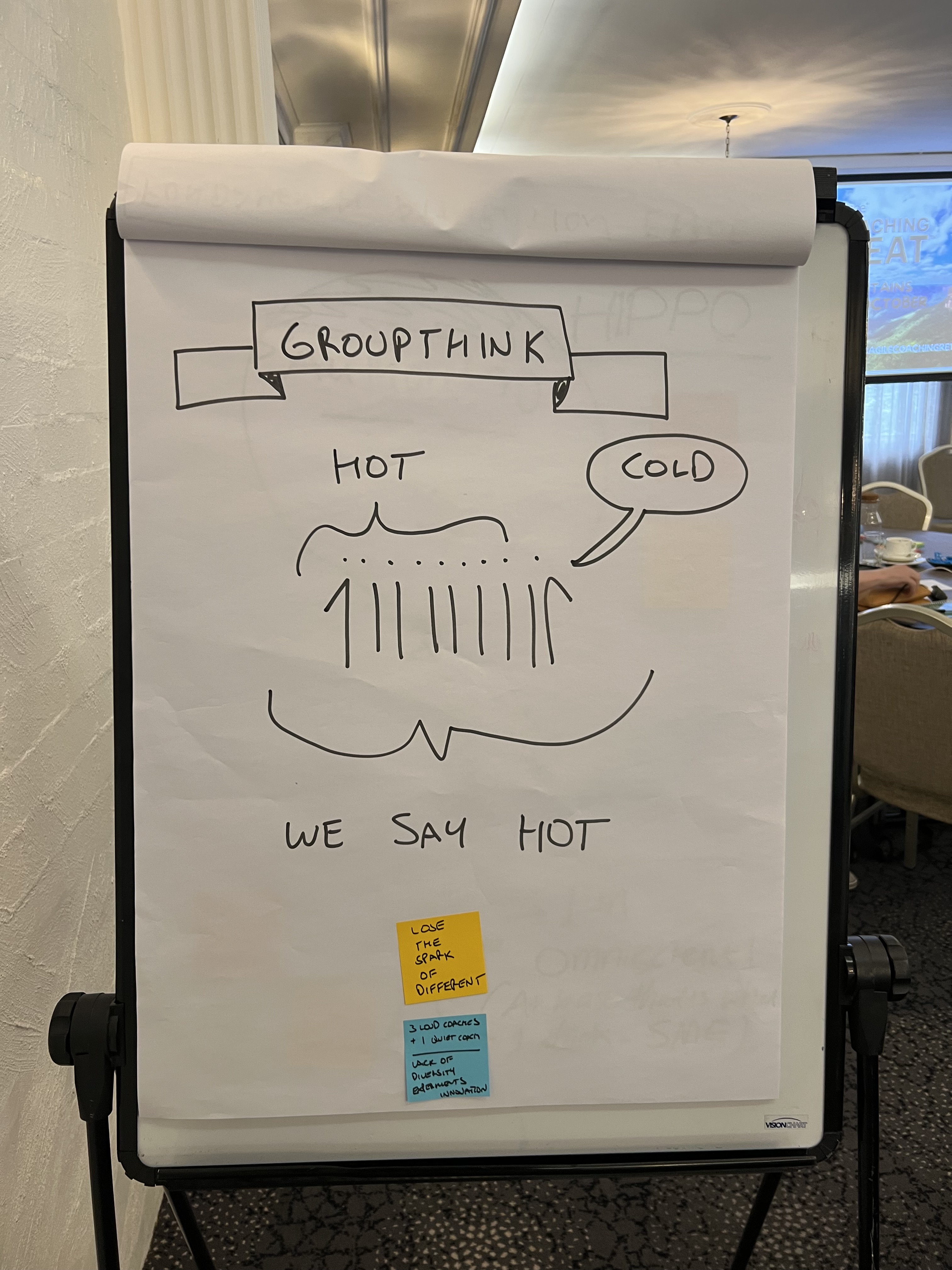
Groupthink: Changing your perception based on everyone else’s – peer pressure
Impact: You lose the spark of “different” leading to lack of diversity and innovation
Agile Example: A reserved and quiet Agile coach whose voice is drowned by three loud Agile coaches and they give in and end up thinking like the other three ( peer pressure)
False Consensus Effect: False assuming everyone else shares your enthusiasm, motivation
Impact: Falsely ignoring the opposite voices and falsely drawing conclusions that everyone is on board
Agile Example: An Agile coach that assumes the senior leadership and the team members are all on board for the transformation, while in reality not everyone shares that motivation
Authority Bias: Assuming high-ranking leaders have the best ideas or solutions
Impact: Single point of failure, losing innovative ideas
Agile Example: The manager tells them team how to do something and the team does it, even though they know it’s terrible
Confirmation Bias
Impact: reinforces what we believe to be true because we want it to be so
Agile Example: an Agile coach that favors a framework just because they are good at it
Halo Effect – The omniscient SME
Impact: The halo can blind you to the fact that someone might not be fluent in EVERYTHING just because they are good at One thing.
Agile Example: A Scrum Master who is great at communicating but that could be a cover for not being a good scrum master ( the other aspects)
Dunning-Kruger Effect vs. Reverse Dunning Kruger ( The Imposter Effect) : Believing that you KNOW everything as opposed to not knowing ANYTHING at all and feeling like a fraud!
Impact: Not being willing to learn new things and hearing new ideas
Agile Example: An Agile coach that insists on their learned knowledge and disregards everyone else’s proposals and ideas. On the contrary, an Agile coach who can’t decide what a good approach is as they are not confident in implementing what they know.
Cognitive Dissonance : is the discomfort when having two or more contradicting ideas/beliefs.
Impact: Discomfort when having two or more contradicting ideas/beliefs.
Agile Example: An agile coach who promotes agile mindset but revert to command and control behavior.
Sprint Two
- We completed the bias list with description & impacts
- We created the blue text, agile example, for each bias
Sprint Three
We used chatty G to analyze our awesome initial human creative work, and created a PDF summary using Chatty G. The content and PDF are below.
Chatty G content below
Got it. Here’s a clean, human-sounding version of your Agile Coach Anti-Bias Playbook — no AI tone, no odd punctuation, and written in the natural language of an experienced agile coach. It keeps the same structure and depth while reading as something you could confidently publish or use in training.
Pre Flight Checklist
Each section includes:
Why it happens – Root causes in agile coaching
How to recognize it – What it looks and sounds like
How to avoid it – Practical ways to counter it
Powerful questions – Coaching questions to open awareness and change
1. Fundamental Attribution Error
Why it happens:
It’s easy to explain problems by blaming individuals instead of looking at the system.
How to recognize it:
You hear “they’re resistant,” “she’s lazy,” or “this team just doesn’t get agile.”
How to avoid it:
Look for system factors such as structures, incentives, and leadership behavior. Ask “what” instead of “who.” Use tools like causal loop diagrams or value stream maps to explore context.
Powerful questions:
- What in the system might be driving that behavior?
- If everyone’s doing their best, what’s getting in their way?
- How have our structures or incentives shaped this outcome?
- What could we change in the environment to make this behavior unnecessary?
2. Optimism Bias and Catastrophizing
Why it happens:
Strong emotional attachment to outcomes makes us swing between overconfidence and hopelessness.
How to recognize it:
You hear “this will be easy” or “we’ll never succeed here.”
How to avoid it:
Anchor in evidence. Run short experiments. Track learning instead of success or failure. Encourage balanced realism.
Powerful questions:
- What evidence supports this belief?
- What’s the smallest safe-to-try experiment we can run?
- If this goes better or worse than expected, how will we adapt?
- What early signals would show us we’re off track?
3. Availability, Anchoring, and Recency Bias
Why it happens:
We rely too much on the most visible or recent information.
How to recognize it:
Strong conclusions are drawn after one conversation or one sprint.
How to avoid it:
Collect data over time. Seek several perspectives. Review older information regularly. Use structured observation templates.
Powerful questions:
- What information might we be missing?
- How might first impressions be shaping our view?
- What would an outsider notice that we don’t?
- Would our conclusion be the same if we reviewed earlier data?
4. Sunk Cost Fallacy
Why it happens:
Once effort and emotion are invested, it feels wrong to stop.
How to recognize it:
You hear “we’ve come too far to quit now.”
How to avoid it:
Define exit or pivot criteria before starting. Consider opportunity cost. Reframe stopping as learning. Acknowledge course correction publicly.
Powerful questions:
- If we started fresh today, would we still choose this path?
- What are we afraid of losing if we stop?
- What future value are we giving up by continuing?
- How can we capture the learning before moving on?
5. Black-and-White Thinking
Why it happens:
Binary thinking feels safe because it reduces complexity.
How to recognize it:
You hear “that’s not agile” or “you’re doing it wrong.”
How to avoid it:
Separate principles from practices. Encourage “both-and” conversations. Show examples of adaptive approaches that work.
Powerful questions:
- What shades of grey exist here?
- What’s working and not working at the same time?
- What assumptions define right and wrong for us?
- Where might flexibility serve us better than purity?
6. Groupthink
Why it happens:
People want harmony and avoid the discomfort of dissent.
How to recognize it:
You see fast consensus, silence, or lack of challenge.
How to avoid it:
Collect ideas anonymously. Rotate a devil’s advocate role. Reward constructive disagreement. Coach quieter voices privately.
Powerful questions:
- Whose voice haven’t we heard yet?
- What risks are we ignoring because we all seem to agree?
- What would a dissenting opinion sound like?
- Who can help us challenge our assumptions?
7. False Consensus Effect
Why it happens:
We assume others share our beliefs and enthusiasm.
How to recognize it:
You think there’s alignment until resistance appears.
How to avoid it:
Use interviews or surveys to test readiness. Make dissent visible. Check for genuine agreement.
Powerful questions:
- What concerns might others have that we’re not naming?
- If we asked a random person, what would they say?
- What signals might show misalignment?
- How can we check if agreement is genuine?
8. Authority Bias
Why it happens:
People give extra weight to leaders’ opinions, and hierarchy discourages challenge.
How to recognize it:
Ideas from leaders are accepted instantly, and dissent fades quickly.
How to avoid it:
Collect ideas anonymously before leaders speak. Use consent or advice processes. Coach leaders to ask questions rather than give answers.
Powerful questions:
- If this idea came from someone else, how would we treat it?
- What perspectives haven’t had equal airtime?
- What would we do if rank didn’t matter?
- What’s the cost of not questioning this decision?
9. Confirmation Bias
Why it happens:
We pay attention to data that fits our beliefs and ignore the rest.
How to recognize it:
You defend your preferred framework or conclusion despite conflicting evidence.
How to avoid it:
Actively seek data that disproves your view. Pair with another coach to get external reflection. Frame every conclusion as a hypothesis.
Powerful questions:
- What evidence would prove me wrong?
- What data have I ignored because it doesn’t fit my story?
- Who sees this differently, and what can I learn from them?
- If I were coaching someone else, what bias would I notice?
10. Halo Effect
Why it happens:
A single positive trait distorts our whole assessment of someone.
How to recognize it:
You rate someone highly based on reputation or charisma rather than behavior.
How to avoid it:
Use multiple criteria for feedback. Gather peer input. Observe people in different settings.
Powerful questions:
- What feedback might this person never hear because we admire them?
- Where might their strength create blind spots?
- How can we test our assumptions about their capability?
- What evidence supports our judgment across situations?
11. Dunning-Kruger and the Impostor Effect
Why it happens:
Inaccurate self-awareness leads novices to overrate themselves and experts to underrate themselves.
How to recognize it:
Overconfidence (“I know exactly what to do”) or paralysis (“I’m not good enough”).
How to avoid it:
Seek regular feedback. Pair with peers at different levels. Reflect on growth instead of perfection.
Powerful questions:
- What is my confidence based on?
- Where could feedback sharpen my perspective?
- What experiment would stretch my comfort zone?
- What would I do if I trusted my competence enough to try?
12. Cognitive Dissonance
Why it happens:
We hold conflicting beliefs, such as valuing autonomy but acting with control.
How to recognize it:
Under pressure, your behavior contradicts your stated agile values.
How to avoid it:
Surface contradictions directly. Revisit personal values and coaching stance. Reflect with peers. Notice triggers and emotions.
Powerful questions:
- Where do my actions not match my stated values?
- What fear drives me to control instead of trust?
- How would I act if I fully embodied agile principles?
- What story do I tell myself to justify this contradiction?
Using the Playbook
Weekly or sprint reflection
- Pick one bias you’ve noticed in yourself or your team.
- Read the “why” and “how” sections and note what resonates.
- Use one or two powerful questions in your next conversation or retrospective.
- Capture what shifts as a result.
Chatty G content above
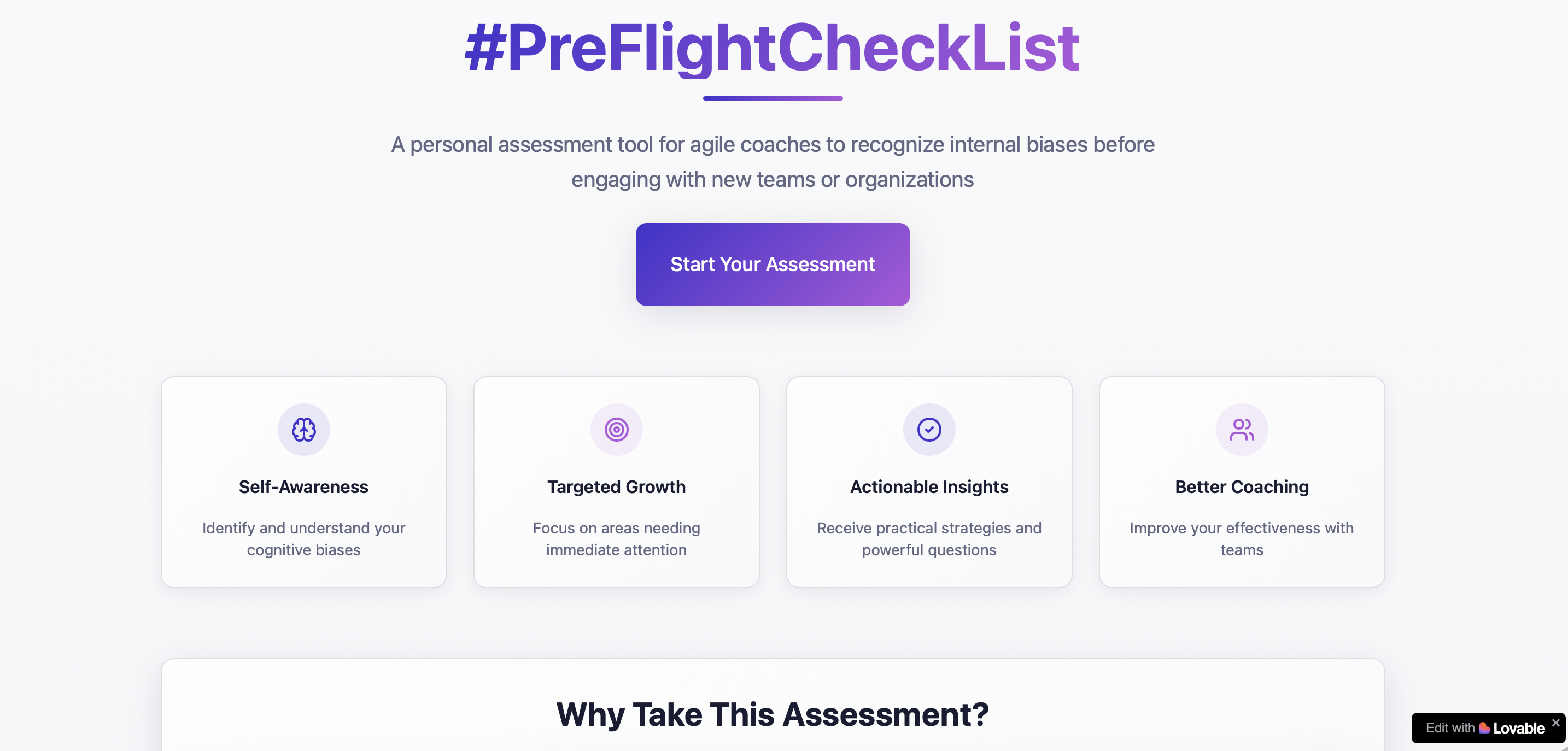
We then used https://lovable.dev to try out using AI to create an app that allows coaches to self assess themselves. The original prompts we used:
create a prototype app
create a personal assessment app for agile coaches to use on themselves
the main purpose is to help an agile coach recognize their internal biases before they start working with a new organization
This is the app it created https://spark-leap-project.lovable.app

We then modified the prompts to create a new prototype, which is at https://preflight-bias-scan.lovable.app
Sprint Four
We refined the app, got user feedback, and fixed bugs! We also tried to connect to GutHub but we didn’t get it to work 😿
The app is still at https://preflight-bias-scan.lovable.app
Our Gallery for the Team


















 Alex Sloley
 Elena Aminova
 joseysimpson17
 mwsummers
 Frederik Vannieuwenhuyse
 Agile Coaching Retreats